Recently Injured? Confused? Have Questions?
We Have Answers To Common Questions!
If you’ve been injured, Elle Rudisill Law Firm is here to help and you deserve compensation. Request a free personal injury case review with no cost or obligation, and get trusted legal guidance from your personal injury attorney serving Pasco, Hernando, Pinellas, Hillsborough, and surrounding counties.
What should I do immediately after an accident?
Protecting yourself after a car crash starts from the very first moments. What you do next can make or break your injury claim. Follow these critical steps to safeguard your rights, your health, and your case:
1. Call Law Enforcement to the Scene
Always request that a Law Enforcement Officer (LEO) respond to the crash — do not settle for a simple Driver’s Exchange. LEOs are neutral, trained professionals who determine fault and document the facts in a formal crash report. Without this investigation:
- You will not receive an official crash report.
- You will not have the officer’s professional opinion on who caused the crash.
- The insurance company may dispute liability.
Stand firm and insist on a full crash investigation. Give your version of events clearly and confidently. Do not let the other driver or anyone else intimidate you into staying quiet.
2. Take Photos of Everything
Evidence disappears quickly — capture it immediately. Take pictures of:
- Your vehicle
- The other driver’s vehicle
- The crash scene and surroundings
- Any visible injuries on your body
If it’s safe, photograph the vehicles before they are moved. If you’re too injured, ask a friend, family member, or bystander to take pictures for you.
3. Identify and Gather Witnesses
Unbiased witnesses can make or break a car crash case. Be sure to:
- Get their full name, phone number, and address
- Ask what they saw and what they could testify to
- Document their statements while everything is still fresh
Remember: evidence is everything in a car crash claim.
4. Call Elle Rudisill Law Firm Immediately
Before you talk to any insurance company, call Elle Rudisill Law Firm at 813-920-ELLE (3553). Insurance adjusters treat unrepresented victims differently—and not in your favor. With Elle Rudisill Law Firm on your side, you have:
- A dedicated advocate protecting your rights
- Guidance on what to say (and what not to say)
- Strong protection from insurance tactics
Never give a recorded statement to any insurance company without consulting the firm first. A recorded statement can seriously damage your case. Once you hire Elle Rudisill Law Firm, make sure to stay in communication. Clear, consistent communication is vital for a successful injury claim.
I am Pregnant. What Should I do during and after a car accident?
If you are pregnant and involved in a car accident, your health and your baby’s safety must be the top priority— even if the crash seems minor. Pregnancy can mask or delay symptoms, and trauma that appears insignificant may still affect the fetus. The following guidance explains what to do during and after a car accident while pregnant.
What to Do Immediately During a Car Accident
1. Call 911 right away
Request emergency medical assistance and report that you are pregnant. This ensures first responders treat the situation with appropriate urgency.
2. Remain as still as possible
Unless you are in immediate danger (fire, traffic risk), avoid moving until paramedics arrive. Sudden movement can worsen internal injuries.
3. Wear your seatbelt correctly if still in the vehicle
If conscious and able, ensure the lap belt is positioned under your belly, across your hips, and the shoulder belt is across your chest — not your abdomen.
4. Tell first responders you are pregnant
Provide details about how far along you are and whether you feel pain, contractions, dizziness, or reduced fetal movement.
What to Do Immediately After a Car Accident
1. Get an Attorney
If you are pregnant and involved in a car accident, contacting an attorney early is strongly recommended. An attorney can explain your rights, insurance coverage, and options so you can make informed decisions while focusing on your health and your pregnancy.
2. Get Medically Evaluated Immediately
Even if you feel “fine,” you should be evaluated by a medical professional as soon as possible. This is especially important to check for pregnancy-related complications such as:
- Pre-eclampsia
- Pre-term labor
- Placental issues
- Changes in fetal movement
If your belly hits the steering wheel or seatbelt, you should seek medical evaluation immediately, regardless of pain level.
3. Go to the Right Medical Facility
When in doubt, err on the side of caution and seek emergency care. Go to the hospital immediately if the accident involved:
- Bleeding
- Head injury
- Severe pain
- Loss of consciousness
- Any traumatic impact
Urgent care, walk-in clinics, or chiropractic care may be appropriate if:
- The accident was minor
- There are no emergency symptoms
- You are advised by a medical professional that hospital care is not required
After leaving the medical facility, contact a medical provider immediately if you experience:
- Abdominal pain or cramping
- Vaginal bleeding or fluid leakage
- Contractions
- Dizziness or fainting
- Headaches or vision changes
- Reduced fetal movement
These symptoms can appear hours or even days after the crash. Even if you were cleared in the ER or urgent care, schedule a follow-up appointment with your obstetrician as soon as possible. Your OB-GYN may order additional ultrasounds or monitoring to ensure continued fetal health.
4. Understand Insurance Coverage
Many people believe they are “fully covered,” but that is often not the case — especially when it comes to bodily injury liability coverage. An attorney can break down coverage and explain what is realistically available. Coverage depends on:
- How many people were injured in the accident
- The at-fault driver’s policy
- Your own insurance policy
5. Personal Injury Questions = Call Elle Rudisill law Firm
If you are unsure whether you should pursue a claim, call Elle Rudisill law Firm to ask questions. There is no obligation to move forward. A consultation allows you to understand:
- Whether you have a case
- What coverage is available
- What the process would look like
6. Accidents Involving Multiple Injured People
If more than one person is injured in the same accident:
- Insurance coverage may need to be split
- All injured parties may need to agree on a payout structure
- Waivers or agreements may be required before settlements are finalized
This is another situation where legal guidance is critical.
What are the different types of Auto Insurance?
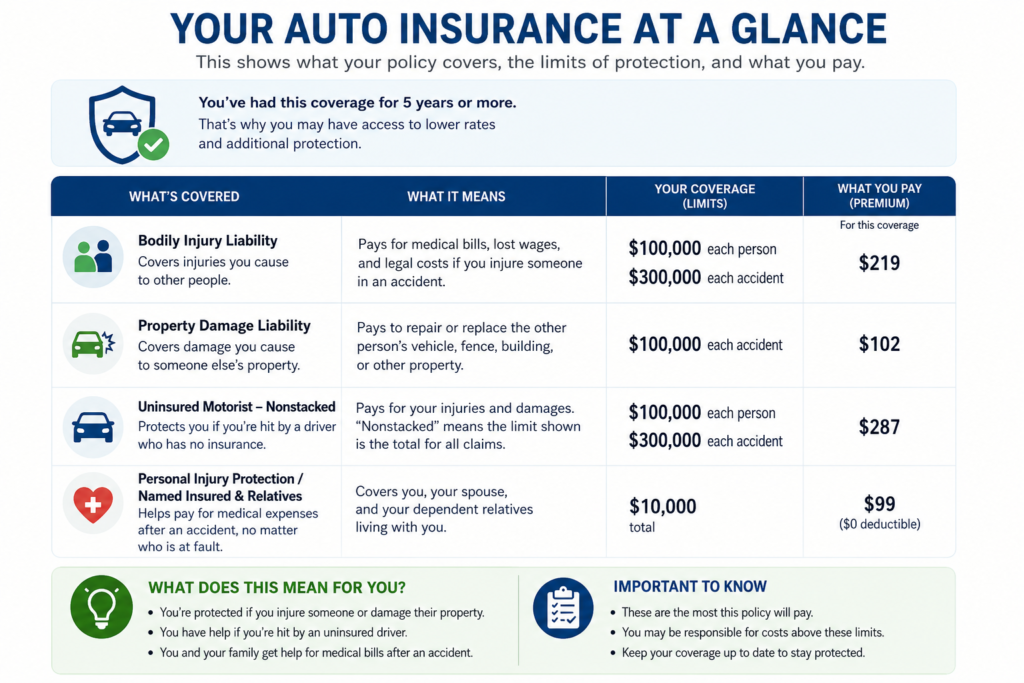
Understanding the different types of auto insurance coverage is crucial if you’re ever involved in a car accident. Knowing what you have — and what the other driver has — can directly determine how much compensation is available for your injuries and damages.
Personal Injury Protection (PIP)
PIP is Florida’s no-fault insurance and is required in Florida. It pays your medical bills and lost wages regardless of who caused the accident. Key points you must know:
- You must seek medical treatment within 14 days of the crash, or you lose your PIP benefits.
- To access the full $10,000, you must receive an Emergency Medical Condition (EMC) determination from a qualified medical provider.
- Without an EMC, PIP may only pay up to $2,500.
PIP typically covers:
- 80% of medical bills
- 60% of lost wages
- Some out-of-pocket expenses
- Travel mileage for medical appointments
Bodily Injury (BI) Coverage
Covers injuries you cause to someone else. Bodily Injury Coverage pays for the injuries sustained by the other driver or passengers if you are at fault. This includes:
- Medical bills
- Future medical expenses
- Lost wages
- Pain and suffering
- Permanent disability
In Florida, BI is not required, which is why many accident victims struggle to recover compensation — because the at-fault driver might have no BI coverage at all.
Uninsured/Underinsured Motorist (UM/UIM) Coverage
The most important coverage you can carry. UM/UIM protects you when:
- The at-fault driver has no Bodily Injury insurance, or
- They have very low limits that are not enough to cover your injuries.
UM/UIM steps in and pays:
- Medical bills
- Lost wages
- Pain and suffering
- Ongoing and future damages
This coverage is critical in Florida because a large percentage of drivers carry no BI insurance.
Property Damage Liability (PDL)
Required in Florida. PDL pays for damage you cause to someone else’s vehicle or property. It does not pay for your own vehicle damage.
Heath Insurance
You will get to use both your PIP and health insurance because they work hand in hand. After PIP is used up, then health insurance will kick in to continue your medical treatment. Beware: health insurance comes with medical liens.
When Should You Consider Hiring A Lawyer?
Any time you’ve been the victim of a car accident, it’s important to have an attorney protecting your rights and fighting for the compensation you deserve.
What If Your Injuries Are Minor?
Even minor injuries can hide serious problems you may not feel right away. Bruises, soreness, or small cuts can still lead to long-term damage, especially to your neck or back. An attorney can help you get proper medical care and make sure your injuries are fully documented. At Elle Rudisill Law Firm, we fight to ensure you receive the treatment and compensation you deserve — no matter how minor your injuries may seem.
Minor Injuries Vs. Serious Injuries?
Whether your injury is minor and requires chiropractic care or serious and needs surgery and physical therapy, we’re here to guide you every step of the way. Our job is to fight for the maximum settlement you’re entitled to. With strong negotiation skills, we work to reduce your medical bills and increase the money that goes directly into your pocket.
Should You Hire a Personal Injury Lawyer or Handle Your Claim?
You can handle a personal injury claim on your own — but you won’t get the same results. Without an attorney, you’ll deal with constant runarounds, delays, and lowball offers. When you hire a lawyer, the insurance company immediately takes your case more seriously and assigns a more experienced adjuster with higher authority to negotiate. This means your claim is treated with more respect — and you’re far more likely to receive a higher settlement.
How Much Does It Cost to hire a personal injury lawyer in Florida?
Our firm operates contingency fee basis, which means you pay no upfront costs. We only receive a fee if we successfully recover compensation for you.
How Long Do I Have to File a Personal Injury Claim in Florida?
In Florida, the statute of limitations for most personal injury claims is four years from the date of the accident. Because legal and factual issues can arise — such as delays in discovering injuries or gathering evidence — it’s wise to consult a personal injury lawyer as soon as possible to ensure your rights are fully protected.
What should I bring to my first consultation with a personal injury lawyer?
To help us fully understand your situation and offer the most accurate guidance, please bring any documentation you have related to your accident or injuries, including:
- Medical records and bills
- Police or incident reports
- Photographs or videos of the scene, vehicles, injuries, or property damage
- Insurance information and any correspondence with insurance companies
- Witness names or contact information, if available
- Any notes or timelines you’ve kept about the accident or your medical treatment
Bringing these items helps us evaluate your case more efficiently and provide you with clear next steps.
What Are Some Misconceptions of personal injury law?
There are several common misconceptions about Personal Injury Law. Unfortunately, personal injury — especially cases involving car accidents and bodily injuries — is an area most people know very little about until they are suddenly thrown into the process themselves. Education is power. The more you understand about how these cases work, the better prepared you are to protect your rights and manage expectations if you have been injured.
Misconception #1: “I got hit. I get my money right away… right?”
This is one of the most widespread misunderstandings. Many people assume that because they were not at fault, they will receive compensation quickly. In reality, personal injury cases take time — anywhere from 3–6 months to 3–4 years, depending on the facts and complexity. Why does it take so long? Insurance companies require proof that:
- You are actually injured, and
- The injuries were caused by the crash.
That proof comes entirely from your medical treatment.
Understanding the Treatment Process
Depending on your injuries, treatment may be brief and involve chiropractic care, physical therapy, or diagnostic testing such as MRIs. In more serious cases, you may require surgery followed by extensive rehabilitation. This recovery process cannot be rushed. Insurance companies will not negotiate until:
- Your treatment is complete, or
- You reach maximum medical improvement (MMI).
Once that happens, your attorney gathers all medical records and bills and presents a demand package to the insurance adjuster.
Settlement vs. Litigation
If negotiations are successful:
- The insurance company issues payment.
- Your attorney pays the outstanding medical bills from that payment.
- You receive the remaining balance.
If negotiations fail, the case must move into litigation. Litigation can extend your case by years, and in some circumstances, the matter may go all the way to trial, where a jury decides the outcome.
The Most Important Thing to Remember: Patience
Personal injury cases are a process, not an instant payout. Your primary focus should always be on healing and following your medical providers’ recommendations. While the legal process unfolds, your health and recovery remain the top priority.
Where Is My Million Dollars???
Many car accident victims believe they are automatically entitled to a million-dollar settlement. It is an understandable misconception. Billboards and advertisements often highlight massive results — “They got me $2.5 million!” or “I walked away with $800,000!” What those ads do not show is the full context.
The truth is that most personal injury car accident cases settle for far less, and there are legitimate reasons why. Personal injury settlements are determined by three core factors:
1. Available Insurance Coverage
Your recovery is limited by the amount of applicable insurance coverage. If the at-fault driver carries only $10,000 in bodily injury coverage, then:
- The maximum possible settlement is $10,000
- Medical bills, attorney’s fees, and costs come out of that amount
- You cannot collect money that simply does not exist
Even if your injuries are severe, insurance limits are often the main restricting factor.
2. The Severity of Your Injuries
A million-dollar policy does not guarantee a million-dollar payout. If the victim has only minor injuries, such as bruising or short-term soreness, the settlement will reflect the medical evidence — not the policy limit. On the other hand:
- Serious, permanent injuries
- Significant medical treatment
- Long-term impairment or disability
These factors increase the case value. In personal injury, injury severity directly impacts compensation.
3. Liability (Who Is at Fault)
If there is any dispute about who caused the crash, the case may require litigation. When liability is uncertain, insurance companies fight harder, delay longer, and sometimes offer little to nothing. Without clear liability:
- There is always a possibility that the victim may recover nothing
- Settlement offers are significantly lower
- The case may need to go to suit
What should you do with your settlement money?
Finish your treatment, invest the leftover money, and avoid spending the money all in one night or lavishly.
contact elle rudisill Law firm
We Put Your Recovery & Compensation First
Elle Rudisill Law Firm represents individuals and families who have been injured due to the negligence of others. Our practice focuses exclusively on personal injury law, allowing us to provide knowledgeable, strategic, and client-focused representation in matters including:
✔ Car Accidents
✔ Truck Accidents
✔ Bus Accidents
✔ DUI-Related Accidents
✔ Motorcycle Accidents
✔ Pedestrian Accidents
✔ Bicycle Accidents
✔ Slip and Fall Accidents
✔ Premises Liability
✔ Negligent Security
✔ Serious & Catastrophic Injuries
Each case is handled with personalized attention, a thorough investigation, and a results-driven approach to pursuing the maximum compensation available under the law.
Free consultation. No win, no fee. We come to you.
How fast can I speak to a lawyer?
As quickly as it takes to dial the phone.
How important is timing after an accident?
Extremely important. In Florida, Personal Injury Protection (PIP) benefits can be lost if you do not seek treatment within 14 days of the accident. Delays also weaken the overall claim.
What happens if I delay treatment?
Insurance adjusters may argue that your injuries came from another event rather than the accident.
What if I post online after an accident?
You should not post about your accident. If you do post, avoid activity-related content and never contradict your claimed injuries.
What if I exaggerate my injuries?
You should never exaggerate. Medical imaging such as MRIs can reveal inconsistencies, and exaggeration can lead to serious legal consequences.
What if I quit my job?
Do not quit your job. Quitting can negatively affect wage-loss claims and raise questions about credibility.
Why should I hire a local lawyer?
A local attorney is more invested in you and your case. They understand local courts, insurers, and procedures, and they are more accessible throughout your case.
What experience should my lawyer have?
Your attorney should have at least several years of experience handling auto injury cases specifically. Experience directly impacts negotiation strategy and case outcomes.
What happens during a consultation?
During a consultation, the attorney will discuss:
- What happened in your accident
- Whether insurance coverage exists
- Who may be liable
- Whether you have a viable case
If you choose to move forward, you can sign with the firm, and the attorney will immediately contact the insurance companies on your behalf.